Chief Scientist
Tai-Wen Hsu
With the increasing availability of observational data and the advancement of numerical modeling approaches, the energy potential of both the Kuroshio and tidal currents should be comprehensively reviewed and reassessed to identify optimal deployment sites around Taiwan where the water is between 50−400 m and support future energy planning and development strategies.
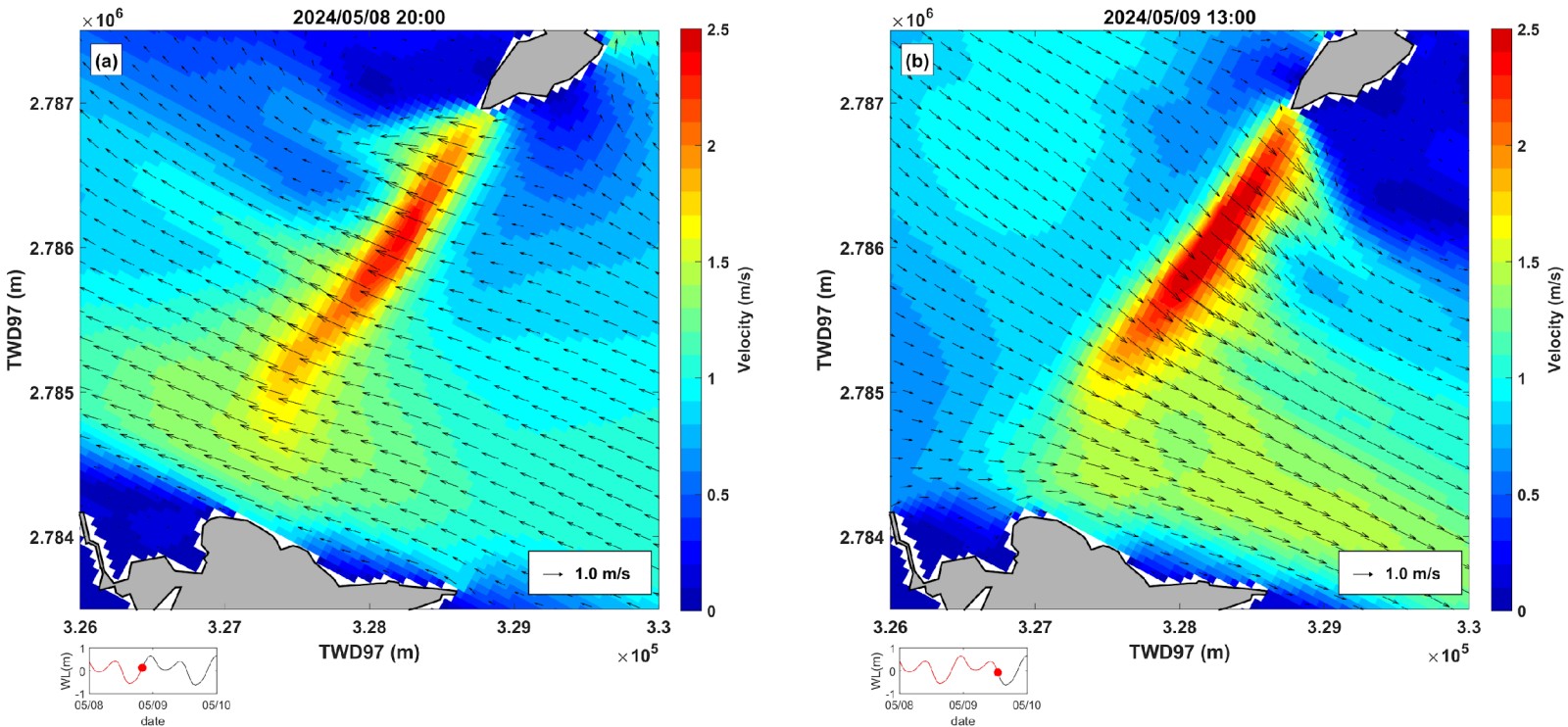
In addition to ocean current power generation, tidal current energy represents another crucial focus for Taiwan’s future green energy development. Compared to the environment in deep water and potential path variations of the Kuroshio Current, tidal currents exhibit high periodicity and predictability (e.g., Draper et al., 2014; Lewis et al., 2015; Buenau et al., 2022; Khojasteh et al., 2022). They are typically concentrated in shallower coastal straits or narrow channels, such as the Keelung Sill (Fig. 1), the Penghu Channel, or the estuaries along Taiwan's western coast, providing unique advantages for resource assessment and initial development. With the increasing maturity of underwater hydrokinetic technologies, deploying turbine systems in tidal sites with high potential has become a key trend in global marine energy development. However, whether deployed in the Kuroshio of the deep ocean or coastal tidal zones, these underwater power generators must withstand severe and continuous physical forcing from the marine environment. In light of these challenges, to further enhance the study of mooring systems in the deep sea for floating hydrokinetic platforms, detailed investigations into mooring design and array layout configurations are required.
This subproject aims to comprehensively review and reassess the development potential and candidate sites for ocean and tidal current energy around Taiwan, while concurrently advancing research on deep-sea mooring systems for floating hydrokinetic platforms. Building upon updated long-term in-situ observations, satellite-derived surface currents, high-frequency (HF) radar measurements, and high-resolution numerical modeling outputs, this study will systematically evaluate current velocity distributions, seasonal and interannual variability, extreme-event impacts, and vertical shear structures in key regions, such as the Kuroshio mainstream and branch currents, the Penghu Channel, the Taiwan Strait, and the southeastern offshore waters. Standardized assessment metrics will be employed to quantify energy density, capacity factors, and resource stability. Simultaneously, factors including bathymetry, seabed conditions, grid accessibility, marine protected areas, navigation routes, and environmental constraints will be incorporated into a multi-criteria site suitability analysis, integrating the specific engineering requirements of mooring systems. The project will further reassess previously identified high-potential sites under updated climate variability scenarios, including marine heatwaves and typhoon-induced flow modulations. The expected outcomes include an integrated, data-driven resource map for ocean and tidal current energy, as well as a ranked list of technically and environmentally feasible priority sites. Furthermore, the proposed optimization strategies for deep-sea mooring systems and array configurations at high-potential sites will help overcome existing engineering challenges, thereby supporting the sustainable development of marine renewable energy and national energy transition planning. Finally, the potential impacts of development activities on the ecosystem will be thoroughly investigated to ensure environmental sustainability.

Annual goals
- Year 1 :
-
Data Integration and analysis
1. Collect long-term current observations, including in-situ buoys, research vessel, and HF radar measurements.
2. Collect long-term and high-resolution model current products around Taiwan.
3.Collect high-resolution bathymetry with detailed seabed condition for site selection.
4.Review and reassess potential site for current energy potential.
5.Conduct a preliminary evaluation of deep-water mooring feasibility, including water depth constraints and seabed suitability for anchors. - Year 2 :
-
Enhanced Assessment and model development
1. Quantify and evaluate current products among observations and numerical models.
2. Estimate current energy potential around Taiwan from combined ocean current and tidal currents; assess potential sites according to the current energy potential.
3. Develop solutions for extracting current energy.
4. Evaluate candidate deep-sea mooring configurations. - Year 3 :
-
1. Develop AI-based prediction for current velocity and direction over suitable sites.
2. Simulate interactions.
3. Investigate array layout optimization. - Year 4 :
-
Prediction and sustainability
1. Continue evaluate realtime current energy potential.
2. Develop a comprehensive framework for hydrokinetic turbine deployment, integrating site selection, mooring design and array configuration.