Chief Scientist
Yu-Heng Tseng
Global ocean forecasting is fundamentally important for supporting climate science and the marine ecosystems. In particular, accurate forecasts are essential for building disaster prevention systems to reduce human casualties and economic losses. Traditionally, ocean forecasting systems have mainly depended on physics-driven models (Cui et al., 2025; Xiong et al.,2023; Kurth et al., 2023) based on environmental fluid dynamics and thermodynamics to predict ocean circulation including currents, salinity, and temperature fields. Over the decades, the accuracy of ocean numerical forecasting has significantly improved; however, Shu et al. (2026) mentioned these models still face two major challenges. First, they are typically computationally expensive and time-consuming due to the complexity of solving physical partial differential equations. Second, sub-grid processes arise from physical phenomena in the real ocean whose spatial scales are smaller than the model resolution, and therefore cannot be explicitly resolved.
With recent advances in Artificial Intelligence (AI), deep learning methods (Lupin‐Jimenez et al., 2025) have been widely applied to various prediction and forecasting tasks across different fields, including ocean science. Pure AI approaches, referred to as data-driven models (Wang et al., 2024), primarily capture statistical patterns and have achieved comparable or even better prediction results in global medium-range forecasting than current numerical prediction methods (Bi et al., 2024). Due to the site-specific modeling strategy, one significant advantage of data-driven models is that they accelerate forecasting speed by several orders of magnitude; nevertheless, these methods are very weak in terms of physical interpretability (Young et al., 2024). To make matters worse, they are often accompanied by violations of conservation laws, and instability over long-term time scales.

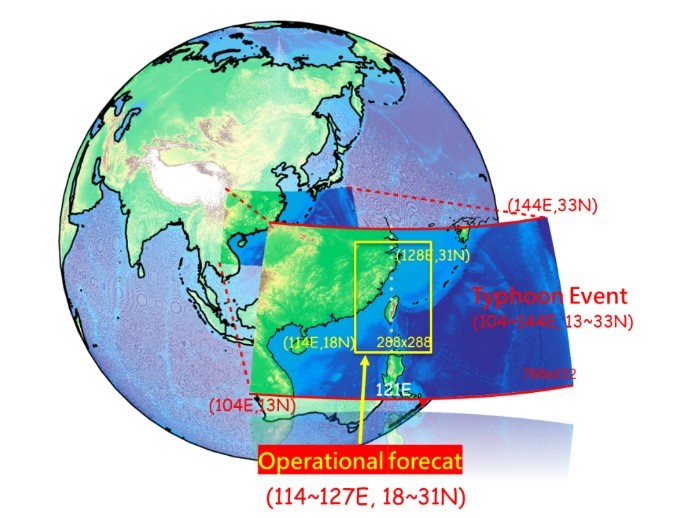
Hence, it is critical to develop a new generation of hybrid forecasting system that integrate the strengths of both numerical methods and AI approaches. In this project, Taiwan Multi-scale Community Ocean Model (TIMCOM) is employed since TIMCOM is an advanced, efficient, and user-friendly ocean modeling framework (see Fig. 1). Designed for multi-scale studies, it handles phenomena from coastal bays to global ocean circulation, incorporating adaptive grid-coupling and parallel computing for improved efficiency (Young et al., 2012; Tseng et al 2022). To develop hybrid forecasting, an innovative AI method integrates traditional ocean model output with observational data collected by TOPMOON to assist in parameterization and the selection of initial and boundary conditions for numerical simulations. More specifically, AI algorithms can be used to capture local-scale patterns, thereby enabling a better comprehension of the ocean environment, to enhance regional numerical ocean forecasting.
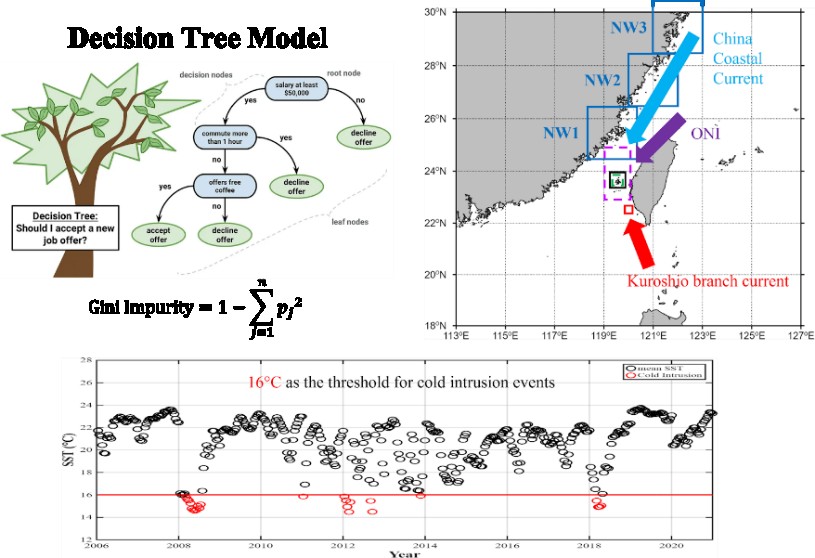
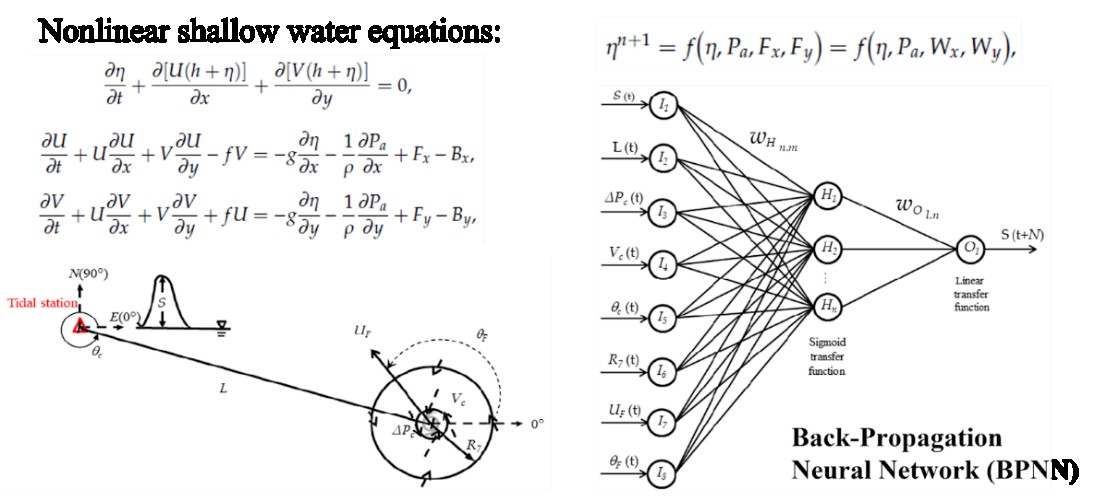
In addition, AI approaches can support the interpretation and diagnosis of numerical results obtained from TIMCOM and observational data from TOPMOON, helping to identify triggering conditions, potential disaster patterns and detailed risk assessments, thereby facilitating the establishment of disaster early warning systems. Generally, the effectiveness of disaster early warning systems significantly relies on the capability of regional forecasting systems. In this study, disaster prevention systems for extreme weather events are used both as real-world application examples and as evaluation criteria for forecasting performance. Particularly, cold surges (see Fig. 2) and typhoon-induced storm surges (see Fig. 3) are selected as representative extreme weather events, as climate change has led to a more frequent occurrence of cold intrusions, and eastern Taiwan is located in one of the regions most frequently affected by typhoons. For example, a storm surge model was developed within an ANN-based framework that follows physical principles (Chao & Young 2022). More specifically, a knowledge extraction method (KEM), incorporating backward-tracking and forward-exploration procedures, was applied to analyze the roles of hidden neurons and typhoon parameters in storm surge prediction. Moreover, the feedback from these outcomes is further incorporated into the forecasting process to enhance understanding of the physical laws of the marine environment. By integrating near real-time observations with historical data, AI-assisted methods enhance prediction accuracy, allowing authorities and communities to respond more effectively.
Annual goals
Thus, the objectives are to employ AI to support the diagnosis of observational data, establish early warning systems based on ocean forecasting, and enhance the performance of numerical forecasting through AI-assisted approaches. The annual goals are listed below.
- Year 1 :
-
System Development and Precursor Identification
1) Develop a high-resolution GPU-accelerated ocean forecasting system to improve the representation of ocean circulation processes, specifically under the extreme weather events.
2) Identify key precursors associated with cold surges and typhoon-induced storm surges to establish an AI-assisted forecasting capability for early detection. - Year 2 :
-
Coastal Extreme and Model Enhancement
1) Enhance the GPU-based high-resolution ocean forecasting system to better resolve coastal dynamics and near-shore processes.
2) Apply machine learning algorithm for advanced diagnosis and interpretation of observational and model data. Then, integrate multi-source observations with numerical simulations to develop an early warning framework. - Year 3 :
-
Physically based AI Forecast Framework
1) Develop a next-generation hybrid forecasting system integrating TOPMOON observational data, AI algorithms, and GPU-based ocean models to analyze disaster patterns related to extreme weather events.
2) Refine and optimize AI algorithms to improve forecasting accuracy, robustness, efficiency and model interpretability. - Year 4 :
-
Operational Optimization & Performance Validation
1) Further improve physical parameterizations, optimization and data assimilation strategies within the hybrid forecasting framework.
2) Integrate these advancements into the early warning system to enhance disaster forecasting capability and systematically evaluate the overall performance and reliability.