Chief Scientist
Vianney Denis
Chih-Lin Wei
Methods
Coastal shallow reefs are among the most diverse and valuable ecosystems on Earth (Woodhead et al. 2019), yet they are also among the most threatened by accelerating environmental change (Hughes et al. 2017). The combined effects of marine heatwaves, ocean acidification, and oxygen depletion interact with local stressors to drive profound ecosystem reconfiguration (Bijma et al. 2013). In tropical regions, these pressures increasingly translate into widespread coral mortality and the emergence of depauperate reef communities (Lin et al. 2024). In contrast, the erosion of seasonality in subtropical waters (e.g., Ribas-Deulofeu et al. 2023) is fostering the development of novel ecosystems with previously unseen structural and functional configurations (Vergés et al. 2019). Beyond the ecological crisis this represents, the direct consequences of these transformations remain difficult to fully quantify, but they are expected to alter overall reef productivity (Morais et al. 2020, Pessarrodona et al. 2022), with cascading effects on the ecosystem services that reefs provide to coastal populations and beyond (Rogers et al. 2017). These changes also raise One Health concerns, as the frequency and intensity of harmful algal blooms (HABs) are expected to increase with reef degradation, posing growing risks to human health (Bauman et al. 2010).
While monitoring is key to quantifying long-term changes, there is a growing need for frameworks that move beyond retrospective assessments and instead provide early warning, attribution, and actionable information (Tzachor et al. 2023). In this context, digital twins offer a transformative opportunity to convert reefs into continuously updated observatories that link environmental conditions, benthic state, and food-web dynamics to emerging ecological risks (e.g., Apprill et al. 2023). Applied to shallow reef management, a digital twin integrates high-frequency environmental monitoring (temperature, salinity, light, oxygen, pH, chlorophyll a, turbidity, and hydrodynamics) with organismal responses and community condition. Because benthic organisms are integrators of local conditions and often respond rapidly and predictably to environmental stress, they are commonly used as primary indicators of ecosystem state. However, severe stress responses or shifts in benthic composition typically represent “endpoints” (e.g., fleshy macroalgae; Williams and Graham 2019) rather than early signals of a transient dynamics. Relying on benthic state alone limits our capacity to mitigate ecosystem collapse or hazardous transitions.
Because food web structure can provide early warning signals (EWS) of ecosystem shifts (Carpenter et al. 2011), explicitly incorporating energy pathways with benthic descriptors is critical for achieving a mechanistic understanding of long-term change and translating that understanding into effective management actions. In coral reef ecosystems, two contrasting energy pathways are widely recognized, with pelagic subsidies dominating over benthic dependence in sustaining the productivity of healthy reefs (Skinner et al. 2021). Shifts in the magnitude or balance of these energy fluxes can profoundly modify trophic interactions, alter nutrient recycling efficiency, and ultimately change the resilience of reef systems to environmental stress. Using EWS allows the identification of critical thresholds beyond which alerts can be triggered to highlight emerging hazards and support the implementation of actions aimed at reducing risks. In reef systems, such early warning could translate into proactive measures, such as temporarily reducing fishing pressure before visible signs of bleaching occur or strengthening sewage management during periods of elevated environmental stress. They may also enable anticipation of hazardous events, such as HAB outbreaks, by triggering precautionary fisheries closures in areas where risk is high. More broadly, this approach opens the door to emerging management strategies that aim to anticipate and prevent stress rather than merely mitigate its consequences after impacts have already occurred, thus preventing waste of resources in elusive coral restoration efforts (Hughes et al. 2023).
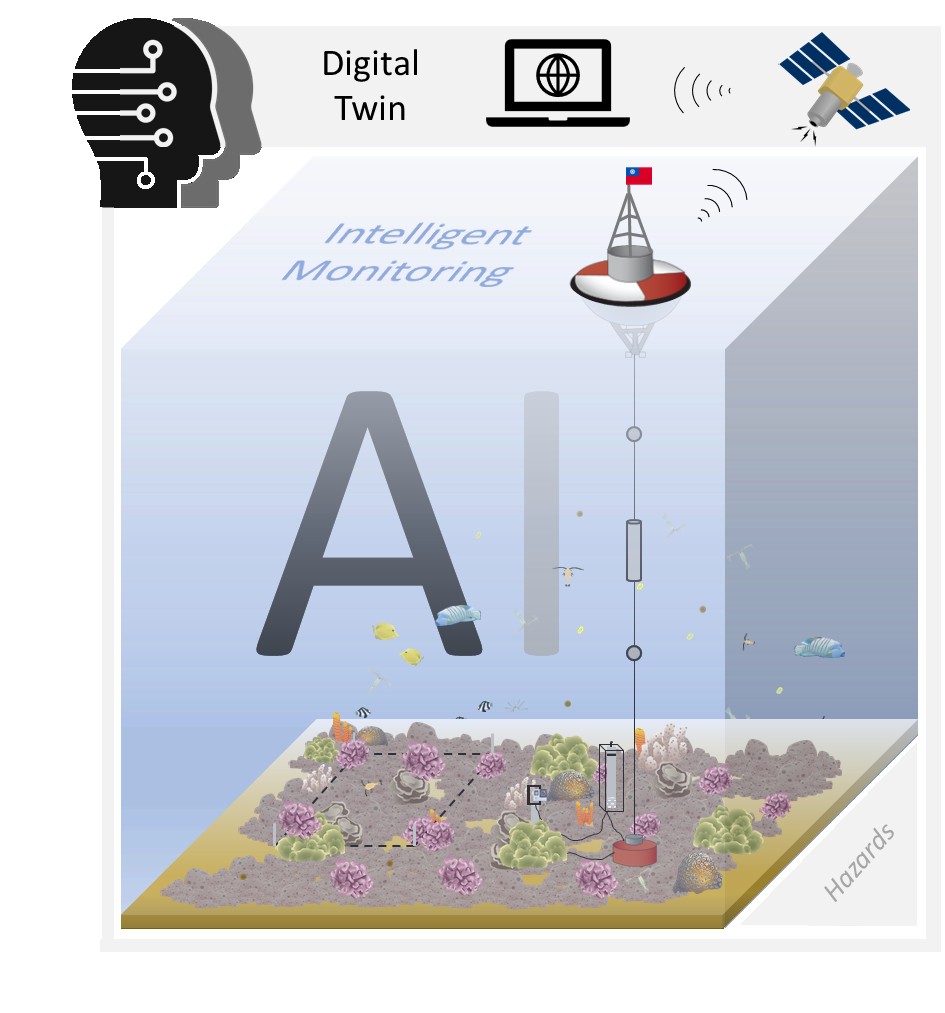
This subproject positions digital twins as the foundation of a long-term monitoring framework for benthic reef environments, coupled with high-resolution environmental records to track shifts in community configuration and ecosystem functioning over time. Beyond documenting changes in composition, the approach will implement intelligent monitoring (iMonitoring) by integrating TOPMOON real time data streams and benthic observations with AI-analytics to detect EWS of reef stress, ecological degradation, and broader socio-ecological risk (Fig. 1). To operationalize this vision, this subproject will establish two monitoring sites representing contrasting subtropical and tropical conditions, enabling comparative analysis of ecosystem trajectories across climatic regimes.

Study sites
The primary long-term site will be Bitou (25°7’33”N, 121°54’55”E), a shallow subtropical system in northern Taiwan characterized by strong seasonality, high environmental variability, and rapid warming (Belkin and Lee 2014). Bitou is particularly well suited for this initiative, as it already experiences episodic thermal stress, signs of benthic restructuring, and increasing anthropogenic pressure (Hsiao et al. 2021). Here, the full digital twin architecture will be implemented, integrating environmental sensing, benthic and food-web monitoring, early warning indicators, and public-facing 360° imagery to test the feasibility of real-time ecological alerts and adaptive management support. Green grassland (22°0’25”N, 121°34’10”E) at Orchid Island (Lanyu) will serve as a tropical reference system with comparatively less variable thermal regimes. This site is experiencing regular typhoons and bleaching events marked by relatively fast recovery (Mulla et al. 2024). Due to logistical constraints, the initial phase at Orchid Island will focus primarily on benthic monitoring, though high-resolution 3D imagery and infauna composition. Notably at this latter site, an annual monitoring of coral reef conditions, initiated by Prof. Yoko Nozawa (University of the Ryukyus, Japan), has been ongoing since 2012.
Data collection
Key indicators of reef status
Besides environmental parameters recorded through the transversal component of this project, ecological monitoring will involve regular assessment of three key indicators of reef status:
Benthic structure.Large-area photogrammetry and repeated high-resolution imagery will be used to generate three-dimensional reconstructions and orthomosaic maps of benthic habitats. Structure-from-Motion (SfM) workflows will allow precise quantification of coral, algal, and invertebrate cover, colony size structure, rugosity, and habitat complexity. These spatially explicit datasets will enable fine-scale detection of compositional shifts, partial mortality, recruitment dynamics, and microhabitat reorganization over time. Integration with AI-based image classification will facilitate automated identification of taxa and functional groups, increasing temporal resolution and consistency while reducing observer bias.
Infauna composition. SCUBA divers will collect the upper 10 cm of reef sediments using three cylindrical PVC cores. Samples will be washed through a 500-µm sieve, and retained material will be preserved in 5% formalin with Rose Bengal dye for faunal sorting. Infaunal biomass will be estimated by summing individual biovolumes, measured with an ocular micrometer under a stereomicroscope, and assuming a specific gravity of 1.13. Biovolume will be calculated from maximum length and width using taxon-specific conversion factors. Infaunal production-to-biomass ratios (P/B) and secondary production (P) will be estimated from temperature, water depth, body mass, and 17 categorical parameters (5 taxa, 7 lifestyles, 4 environments, and state of exploitation) using an artificial neural network (ANN) model. Mass-specific respiration rates will be estimated from body mass and temperature using an empirical model. Further analytical details are provided in Tung et al. (2023).
Foraminifera.
Foraminifera are single-cell organisms that build a calcite shell and occur in shallow settings like Bitou, mainly as benthic species. The formation of a calcite shell is a unique feature that functions as an environmental recorder of water conditions, e.g., from temperature and chemical composition, in which the foraminifer calcifies its shell. As the lifespan of foraminifera is commonly very short, up to a few months, the species composition in a setting like Bitou is likely to change with changing seasons. During this project, living foraminifera, identified by staining with Bengal Rose, will be collected along with seawater samples. Investigations will be performed to determine changes in the community during different seasons, and the geochemistry of their shells will be compared with the chemistry of the seawater as well as with the continuously monitored environmental parameters collected within this project. This will allow calibration of how the environmental conditions are recorded in the shells of the foraminifera. Collecting foraminifera from other locations and analyzing their geochemistry can then indicate how environmental conditions are changing when direct monitoring is not available.
Energy pathways
Through a targeted focus on a dominant coral species at Bitou, long-term seasonal monitoring of coral diet will be conducted using stable isotope analyses of coral tissue and its primary potential food sources. Suspended particulate organic matter (SPOM) will be collected by sequentially filtering seawater through 200 μm, 20 μm, and 2 μm meshes, broadly separating mesozooplankton (>200 μm), microplankton (20–200 μm), and pico- to nano-phytoplankton (2–20 μm) fractions. In addition, benthic particulate organic matter (BPOM) will be sampled from the surface sediment (approximately the top 1 cm layer) during each sampling event to characterize sediment-associated organic resources. To progressively expand the trophic framework toward a broader food-web perspective, other common macro-organisms present at Bitou will also be sampled. Current targets include primary producers (representatives of green, red, and brown algae) and key consumers such as corallivorous gastropods (e.g., Drupella spp.), crustaceans (e.g., hermit crabs), and echinoderms (e.g., Holothuria spp.). Dominant fish species will also be incorporated in future phases to strengthen reconstruction of trophic structure and energy pathways. Stable carbon and nitrogen isotope analysis of organism tissues will be analysed and used to evaluate feeding strategies, trophic interactions, and food chain length, clarifying the energy pathways within the benthic ecosystem (Jennings and Mackinson 2003).
Respirometry
Estimation of metabolic rates (e.g., oxygen consumption and production) provides integrative indicators of organismal and community physiological conditions that cannot be captured by compositional surveys alone.
Sediment community oxygen consumption (SCOC) will be measured using either in situ dark–light chambers deployed by SCUBA divers or ex situ sediment incubations in the laboratory. The chambers will be continuously stirred by a pair of inductively driven magnetic stirrers that direct flow from near the sediment–water interface over the tops of the chambers. For ex situ SCOC, three sediment core tubes will be incubated in a dark water bath. Each cylindrical PVC tube will be sealed with a custom-built lid containing a magnetically driven impeller to circulate the overlying water. SCOC will be converted to organic carbon consumption using a respiratory quotient of 0.85.
Annual goals
- Year 1 :
- Infrastructure and baseline data generation ‒ Deploy environmental sensors and initiate standardized, high-resolution collection of benthic, infaunal, trophic, and metabolic data to establish harmonized baseline datasets suitable for AI ingestion.
- Year 2 :
- Temporal expansion and data harmonization ‒ Expand seasonal and interannual sampling to build dense, multi-layered time series while standardizing formats, metadata, and quality-control pipelines to ensure interoperability and AI-readiness.
- Year 3 :
- Multidimensional data integration ‒ Integrate environmental, structural, productivity, and energy-pathway datasets into a unified, spatially explicit digital twin architecture designed for large-scale analytics and machine-learning applications.
- Year 4 :
- AI-Ready Observatory Deployment ‒ Deliver a fully structured, annotated, and continuously updated reef observatory database optimized for real-time AI analysis, forecasting integration, and future predictive ecosystem intelligence development.